

Features
Abandoned, Beached, or Wrecked?
The life and times of MV River Arc a.k.a. Helene Waller.
Story & Images By John Hopkins and Nicole Skakun
Shipwrecks have fascinated people ever since ships sailed the oceans; the fates of most wrecks lost in time. Known stories involve storms, navigation errors, insurance scams, smuggling, piracy, treachery, warfare, drunken captains, mutinous crews, and rivalries, to name just a few.
Not surprisingly, wrecks abound in the Turks & Caicos and Bahama Islands, an archipelago of reefs, islands, and passages that have challenged mariners for centuries. Wrecking, the enterprise of scavenging the cargos and remnants of ships, was a significant part the economy of The Bahamas in the 19th century when over 2,000 individuals were registered as wreckers. Today, more than 650 wrecks have been documented in the Turks & Caicos.

A Google Earth Image shows the position of the River Arc grounded on the North Caicos barrier reef.
So, what to make of the River Arc that ran aground (variously recorded as abandoned, beached, or wrecked) on the western side of a small cut in the barrier reef north of Pumpkin Bluff, North Caicos, in August 1985? She arrived without cargo and was driven into a blind channel on the western side of the cut. One anchor down, the forward and midships sections grounded on the barrier reef within the cut, the aft section hanging in deeper water. Even unladen there was no possibility that she could enter the North Caicos lagoon by this cut.
Swells accompanying Hurricane Kate that crossed the Caicos Islands on November 18, 1985 lifted the ship and dumped her firmly on the substrate, listing a few degrees starboard, stretching the anchor chain, ending any possible attempts at salvage. Her final resting position is clearly recorded by Google Earth images 2003-09-02 and 2004-09-14 at Latitude 21º58’17”N, Longitude 71º59’42”W. For forty years she lay there wedged in the cut, bathed in warm water, warm salty air, slowly disintegrating through corrosion and battering by waves.
In time, a palimpsest of an earlier name outlined in welding bead appeared beneath the steel embossed final name—the River Arc was born as the Helene Waller. Wilhelm Waller of Germany was involved in maritime trade in the 1930s. After the Second World War he was joined by his son Dieter and nephew Jens to form Reederei Jens and Waller. In 1963, Wilhelm commissioned the Helene Waller, named after his wife. Built in the Brake (Germany) shipyards by the Luring company, the ship was 63.5m long, 10m wide, draft 5.9m, and weighed 499 tonnes, deadweight 1150 tonnes. She was powered by a diesel 800hp engine, one shaft, and one propeller. Fore and mid-ship single masts and aft twin king posts joined by a steel beam were all equipped with loading booms; the ship could serve small European ports that lacked on-shore loading facilities. Registered as a general cargo ship (ID No. 5424160), she was not a container ship, although on occasion she carried a few containers as deck cargo nestled between the aft hold and kingposts. Cargo was loaded in slings and hoisted into two holds: bulk cargo stored loosely, break-bulk cargo of individual crates and packages man-handled and stored separately in the holds or on the Tween deck, a second interior deck between the two holds.

The River Arc was born as the Helene Waller.
Several photographs of her between 1963 and 1975 variously reveal that she was in port in Plymouth (UK) at sea passing up the Severn River on her way to Bristol (UK) and on another voyage, Bayonne (France). A postcard of her with a hand-written message details a voyage between Rotterdam (Netherlands) and Bayonne, August 1966. For a period, she displayed the markings of the Cantabrico Line that plied the Cantabrian Sea, an area of the Atlantic Ocean off southwestern France and northwestern Spain.
In 1976 she was sold to Parker Marine Co. Ltd., renamed Zebras Luck, and registered in Limassol, Cyprus. (A new Helene Waller—a container ship registered number 7711919—was built for Jens and Waller in 1978). In 1979 the Zebras Luck was sold to Paros Sg Enterprises Co., renamed Paros and registered in Piraeus (Greece). A photo taken in the Port of Sharpness (UK) shows the Paros, minus loading booms on the rear king posts, loading by a shore crane, in need of a facelift and repaint.

The River Arc was born as the Helene Waller.
In 1981 the Paros was purchased by ARC Nav Line, SA and registered in Panama as the River Arc. She crossed the Atlantic, then worked out of Miami serving various ports in the Caribbean and South America. In 1983 she underwent refit in Miami River but neglected to pay the service charges.
The subsequent proceeding through the courts is a story that has been preserved on several legal sites as case history. The River Arc, the ship itself, was sued by the service company, and a court warrant of arrest issued to detain her in Miami. In rem, a legal term from Roman Law a millennium or so ago, refers to an object of value that can be sued independent of human ownership. In the following court hearing, the warrant of arrest was rescinded and, as the plaintive omitted to obtain a stay of the proceeding, the ship departed from Miami that evening. By law, in rem applies only when the object is in res, that is, it resides within the geographic jurisdiction of the court; thus, once the ship had left, the in rem jurisdiction was destroyed. The plaintiff appealed to the US Court of Appeals for the Eleventh Circuit but the appeal was denied.
In 1984 she was back in Miami for compass service; a Deviation Certificate 1984-02-22 issued by a licensed compass adjuster showed no deviation anomalies. Her Deck Log records her passage from Guaranao (Venezuela) to Miami, 1984-08-11 to 1984-08-15, past Cape Tiberon (Haiti), and east of Cuba via the Old Bahama Channel and Straits of Florida. The final dated entries in the Deck Log are Miami to Nassau 1984-08-17 and returning to Miami from Nassau 1984-08-19, via the NW Providence Channel, course N-NW-SSE; at 13.00hrs anchored off Miami waiting a pilot.
The Miramar Shipping Index records her as beached on North Caicos 1985-08-21 returning from Castries (Antigua). The times, distances, and locations from these two sources do not compute: one more quirk in the story of the River Arc.
Grounded on the barrier reef around North Caicos she became a curiosity for local boat owners and visitors. Strong wave and tide-induced currents limited access to calm days via a rope ladder draped midship over the western sheltered side. On our first family visit to the ship our daughters, aged 11 and 13, scrambled up the ladder, then encouraged their less agile parents using the spare anchor line from our Boston Whaler.

This composite image depicts the deterioration of the River Arc off North Caicos over a decade.
The first impression on board was rust; four months exposure without the constant maintenance of a working ship had stripped the paint from hatch covers and deck machinery. Brown rust streaks stained the white superstructure. The second impression was that she was silent, empty, deserted, no cargo, no lingering indication that she had ever had a crew, not even graffiti. The lifeboat was long gone, the davits swinging loosely. A few trampled sea charts littered the floor on the bridge along with a torn remnant of a Deck Logbook. A compass deviation certificate hung on one wall; a manual of seafaring lay bruised on the floor. All the character, personality, of the vessel was gone; what was left was a lifeless mass of steel, decaying. A bold osprey had claimed possession of one of the king posts and was building a nest at the crown, pausing occasionally to warn intruders that squatters rights had been established.
For several years she remained intact, rusting progressively. The rope ladder frayed and was replaced by a knotted rope. In 1993 when Nicole was a grade 11 student in North Caicos high school, she and a couple of temporarily adopted brothers camped on board, shared accommodation with the indignant osprey and a million cockroaches, fished, and watched larger predators cruising in and out though the cut.
Over the next decade the ship progressively deteriorated as welded seams joining plates and ribs weakened by corrosion. Along the waterline from mean high tide down, repeated wetting and drying, salt, water, and oxygen worked their wonders. Elemental iron was converted to various iron oxides and hydroxides. The steel fell as rusty flakes and ultimately dissolved in sea water, algae clung to the pitted surface, pits became holes; in effect, the ship was being cut in two horizontally and it became unsafe to climb on board. Sometime around 1997–1998 the inevitable happened: a heavy storm pounded steel sheets and ribs from the side, exposing the interior.
By 2000 it was possible, on high tide on a calm day, to float into her hold in our Boston Whaler. Inside the hull was a stark framework of steel ribs, cross beams, and supports of the Tween Deck. And in this space the ambience changed, a whiff of claustrophobia perhaps, the impermanence of corroding steel, lingering fumes of oil and diesel fuel mixed with sea mist, the subdued growl of breakers on the nearby reef, gentle lapping of waves against the hull, the swirl of water amongst the limbs of this steel skeleton. Eyes closed, one conjured sounds and scenes from the past: the squeal of winches, the screech of brakes, slithering cable overhead, a net sling descending; voices, curses, commands. Bodies stripped to the waist glistening, sweat, muscle; tropical heat in a poorly ventilated steel box.
Subsequent years saw large chunks of the midship section detach, cast into the ocean, and scattered around the wreck site. Testimony to the winter storms that commonly pound the northern North Caicos coast with waves up to 4 m high, and several hurricanes. By 2017, midships had been cut to tide line; the forward and aft sections, being more heavily ribbed and plated, lasted longer.
The aft section consisted of a superstructure—crews’ quarters, galley, mess, and bridge—that overlay the engine room and rudder deck. For a while, the whole section remained intact but progressively listed to port, then the superstructure detached, twisting the underlying hull in the process. Now the engine (arrow) and rudder gear head were exposed. The aft section bent, broke away from the main hull, tilting seaward at 20 degrees; the rudder deck detached and fell into deeper water at the rear end of the ship.
By 2017, the aft section had been cut to waterline, the engine partially exposed at low tide. Marine diesel engines of this vintage were heavy and robust, burning diesel or bunker fuel, very different from their lighter, more powerful, modern relatives.
Viewed from the port side (above) the bulk of the engine appears massive and magnified, shimmering below the swirl of ebbing waters. The exposed part of the engine reveals six cylinders in-line, configured as a four-stroke system. Each cylinder is topped by four spring-loaded exhaust and intake valves, pairs of valves are cross-linked by rocker arms, driven by a push rod from the crankshaft within the belly of the engine. At water level are remnants of the exhaust and air-intake manifolds. Viewed from the starboard side (below) fuel lines linked to fuel injectors are present.
The more strongly braced and plated forward section—fore deck, foremast, anchor winches, Bosun’s locker, and chain locker—would remain intact with the foremast still standing in January 2011. At this time, it appeared that the scarred, hollow-eyed old lady was contemplating her fate with trepidation. Later that year, the foremast toppled, then the deck and sides collapsed down over the chain locker, likely effected by Hurricane Irene, a Category 1 hurricane that passed by in August 2011. Another violent storm swept away the remaining superstructure, so that by January 2023 the chain locker was opened, revealing an impressive pile of rusting links, surrounded underwater by a tangle of ribs, plates, and the two anchors.

The remaining exposed material of the ship will disappear over the next few decades as steel is degraded.
The remaining exposed material of the ship will disappear over the next few decades as steel is degraded. More solid parts that are permanently submerged—chain, anchors, engine, and keel—will last longer, perhaps several hundred years judging from other wrecks, and become the curiosities of future shipwreck enthusiasts. Likely, they will marvel at these remnants of a primitive technology of their unsophisticated ancestors.
John Hopkins is a retired geologist and homeowner on North Caicos. Nicole Skakun (nee Hopkins) is a GIS specialist with an interest in wetlands. Photographs presented in this article were selected from our family compendium of photos from many trips to the River Arc over the past 40 years. Details of her past are from Reederei Jens and Waller, Miramar Shipping Index, and Wrecksite, websites as of September 2024.
To view additional photos of her early years of service, search the Internet using ID No. 5424160. The legal history of the detention of the River Arc in Miami can be accessed through several websites using her name.
What's Inside The Latest Edition?
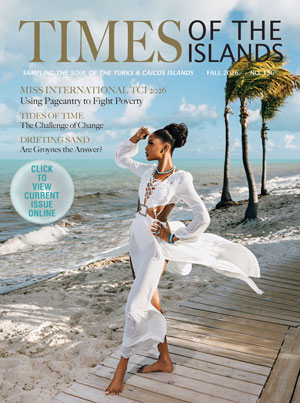
On the Cover
Local photographer Watsonne Morency (www.watsonnephotography.com) took to The Shore Club to capture this image of Miss Turks & Caicos International 2026 Adesha Gustave.
Our Sponsors


Leave a Reply