

Features
Going Deeper
The TCI Whale Project uses research to protect these leviathans of the sea.
By Katharine Hart MSc. and Cathy Bacon MSc., Turks & Caicos Islands Whale Project, Marine Environmental Institute of the Turks & Caicos Islands ~ Photos by Katharine Hart, Deep Blue Charters, under SRP# 2025-01-01-02

The 2025 calf of “Zeppelin” (TCI-107), a Gulf of Maine whale, is spy-hopping to take a better look at a whale watching vessel.
From January to April each year, the waters of the Turks & Caicos Islands become home to North Atlantic Humpback whales (Megaptera novaeangliae). These whales migrate to the warm waters of the Caribbean from their feeding grounds in the colder northern latitudes, using the shallow banks as a nursery and breeding area for a few short months of the year. Along with the whales, humpback enthusiasts follow the same migration, flocking to the islands of Grand Turk and Salt Cay to have the chance to see and, if everything aligns, swim with these incredible ocean giants.
Since 2022, the Turks & Caicos Islands Whale Project (TCIWP) has been studying the humpback whales locally, aiming to collect baseline information to understand the importance of TCI to this population and how they use the area. Having a strong data-set is critical to conservation of these charismatic animals that are so important to the people and the economy of the Turks Islands.
Throughout this time, boat charter companies, hotels and resorts, and interested whale watchers have engaged with the project and submitted photos and videos through an exciting citizen science program. The project uses photographs and videos of the whales to identify individuals and match them both locally and at their feeding grounds. These submissions have contributed information to the TCI database and the TCI Humpback Whale Catalogue, allowing us to identify more whales through photo-ID and gain an even broader understanding of how the whales are using TCI waters.

This is a young whale tail slapping on the Turks Bank. The underside of a humpback whale’s tail is like a fingerprint and the pigmentation develops in the early years of their life.
Identifying humpback whales off the TCI can be challenging because whales are mostly found in shallow water and rarely dive, meaning that images of their tail flukes (a humpback whale’s fingerprint) are primarily underwater images. Videos taken underwater tend to be relatively low resolution which is problematic when trying to get a good image for photo-ID — they are often distorted and dark because of low visibility and particles in the water. All potential identifying features are documented, including the dorsal fin and the pectoral fins, to attempt to identify as many individuals as possible off TCI and record them in the local catalogue. Images collected are matched using Happywhale.com and by hand through comparison with regional scientific catalogues in the North Atlantic.
In October 2025, the TCIWP presented research for the first time at the Humpback Whale World Congress, held in Tadoussac, Canada. The work presented included over four years’ worth of research through an oral presentation, “Spatial distribution, abundance and occurrence patterns of humpback whales on the Turks Bank, Turks and Caicos Islands.” This was complimented by two scientific poster presentations in conjunction with collaborators throughout the North Atlantic: “Migratory destinations of humpback whales on the Turks Banks, Turks and Caicos Islands” and “Annual return and reproductive rates of humpback whales on the Turks Bank, Turks and Caicos Islands.” The conference was an incredible opportunity to publicly introduce the research conducted since 2022 and to connect with other humpback whale researchers in the region and further afield, to share ideas and knowledge, and be inspired to continue working for these incredible whales.
A variety of different group types of humpback whales are recorded throughout the season, including mother and calf pairs, mother and calf with an escort (another whale travelling with them), individual whales, adult pairs, singers, and competitive groups where a number of whales are competing for a female. Mother and calf pairs are the most frequently observed group throughout each season, athough the proportions vary year by year, and month by month within the season. Many of the whales observed return across multiple seasons.

This is a mother and calf pair on the Turks Bank humpback whale nursery ground. This mother, like many others, is a repeat visitor to the Turks & Caicos Islands, showing the importance of our waters to North Atlantic humpback whales.
As research continues, we are gaining a better understanding of which whales we expect to see returning each year. In 2025, 13 returning mothers were identified on the Turks Bank, with 8 of these last seen in 2022 also with a calf. This site fidelity — where the whales return to the same area across multiple seasons — indicates how important this area is to a proportion of the North Atlantic humpback whale population.
The TCI Humpback Whale Catalogue includes matches to all primary feeding destinations in the North Atlantic, including West Greenland; northern Norway; Iceland; Canada, including Newfoundland and Labrador (Witless Bay, Trinity Bay, Saint-Pierre and Miquelon, Bonavista Bay, and Gulf of St. Lawrence); and the Gulf of Maine and the mid-Atlantic stopovers, such as Bermuda, Virginia Beach, New Jersey, and New York. A well-recognised and iconic humpback whale, Pinball (TCI-96), is a female known to feed in the Gulf of Maine. She is the longest-recorded return visitor to the Turks Bank, observed during ten different seasons between 2007 and 2026, six of those seasons with a calf.
A major conclusion drawn from the research is the confirmation that TCI is a humpback whale nursery ground in its own right, when anectodally it has been referred to as a stopping off point along the migratory route to the better known areas of the Silver Bank and Samana Bay in the Dominican Republic. Individual mothers have been recorded on the Turks Bank with their calves for more than seven weeks consistently. This has implications when considering the need for regulations and protections, to ensure that the humpback whales are able to continue to return to TCI without the threat of harassment or habitat degradation.
The humpback whale research conducted by TCIWP would not be possible without the support of the community and individuals who share their sightings and images each year. We are grateful to have consistent local collaborators including Salt Cay Divers, who share daily photos and videos for identification throughout the season, along with a team at Salterra in South Caicos collecting and contributing data on their trips.
Beaked whale stranding

A DECR officer supports the head of the stranded whale on the shoreline of Corktree Beach to take photographs for species identification.
On February 7, 2026, a rare event occurred when a medium-sized Beaked whale stranded in the Cork Tree Beach reef, off the northeast side of the island of Grand Turk. The TCIWP was notified and responded to the scene to assess the individual. Under DECR Scientific Research Permit #SRP-2026-01-01-06, a stranding response occurred, and measurements, photographs, and specimen skin samples were taken of the dead individual for future cause of death investigations. The individual is presumed to be a male goose-beaked whale (Ziphius cavirostris), also known previously as a Cuvier’s beaked whale.
The TCI Government, in collaboration with the Blue Belt Programme, embarked on the RSS James Cook, a British Royal Research Ship operated by the Natural Environment Research Council in TCI territorial waters to conduct marine research. While the ship was docked at the Grand Turk Cruise Port, one sample was given to scientists to run a whole genome sequence on the specimen, as well as metabarcoding for identification and to potentially determine the cause of death.
Goose-beaked whales are among the most commonly seen beaked whale species worldwide. Of all the beaked whale species, they have the widest range and may be found in the majority of the world’s oceans and seas. Tropical, subtropical, and temperate seas are home to goose-beaked whales. They like deep pelagic waters surrounding steep underwater geologic structures, including banks, seamounts, and undersea canyons, as well as the slopes and edges of continents. Male goose-beaked whales, like those of other beaked whale species, have two tiny, cone-shaped teeth that protrude from the tip of their lower jaw and are frequently utilized in fighting.
During the 2025 season, the TCIWP co-authored with colleagues in the Bahamas (Bahamas Marine Mammal Research Organisation), the Lucayan Archipelago Important Marine Mammal Area (IMMA) https://www.marinemammalhabitat.org/factsheets/lucayan-archipelago-imma/. IMMAs are defined as discrete portions of habitat, important to marine mammal species, that have the potential to be delineated and managed for conservation. IMMAs consist of areas that may merit place-based protection and/or monitoring. “Important” in the context of the IMMA classification refers to any perceivable value, which extends to the marine mammals within the IMMA, to improve the conservation status of those species or populations.
The Lucayan Archipelago is located east of Florida and north of the Greater Antilles and includes all the islands of the Bahamas and the Turks & Caicos Islands. This is a complex network of different habitats and depth strata from the coastal habitat out across the shelf, down the slope, and out to the 3,000m isobath. The IMMA includes the network of carbonate banks that define the islands, submarine canyons, and all existing national marine parks and marine protected areas in the region, all of which are known habitats for beaked whales. The IMMA noted that the archipelago is an area with one of the highest known densities of beaked whales in the Caribbean. Goose-beaked whales are regularly sighted and detected acoustically in the Bahamas, and off the TCI, beaked whales are known to occur; there have been a few anecdotal reports.
We hope that the sample we shared with the RSS James Cook will shed some light on the cause of death of this goose-beaked whale. There is a lot to learn about cetacean strandings in the North Atlantic, where cetaceans face an array of natural and anthropogenic threats.
What's Inside The Latest Edition?
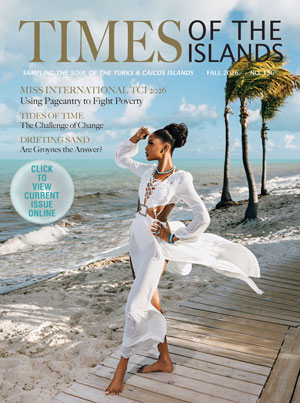
On the Cover
Local photographer Watsonne Morency (www.watsonnephotography.com) took to The Shore Club to capture this image of Miss Turks & Caicos International 2026 Adesha Gustave.
Our Sponsors


Leave a Reply