

Astrolabe
A Journey of Rediscovery
The earliest tokens of the West Caicos Sisal Company.
Story & Images By Eric Schena
(A longer version of this article originally appeared in TAMS Journal, January/February 2026, Volume 66, No. 1)
Beginning in the 1980s, I worked for Gene Brandenburg at Old Town Coin & Jewelry Exchange in Alexandria, Virginia. Gene quickly became a numismatic mentor, and I cut my teeth doing research and attribution for Gene for some of the more out of the way corners of numismatics. Many interesting coins and people came through his shop.
One frequent customer was Mendel L. Peterson, former curator at the Smithsonian Institution and acclaimed diver whose integration of archaeological techniques with shipwreck diving led him to be called the “father of underwater archeology.” Gene had a passion for all things Caribbean. This interest extended into the numismatic realm, so when Mendel came into the shop with two double-row 2×2 boxes of Caribbean coins and treasure coins, our interest was piqued.
The coins included a number of shipwreck pieces Peterson collected in his various expeditions throughout the 1950s and 1960s, including countermarked Spanish colonial pieces and “black doggs” (French colonial billon sous and similar coins), and other more obscure rarities. Gene visited Mendel several times at his McLean home prior to his death on July 30, 2003 at the age of 85. He took notes on the various coins in the collection, recording where and when he found them and other incidental details.
At a Spring 2024 gathering at our monthly Nummis Nova dinner, my dear friend Dave Schenkman brought several tokens to show me, including a lot of four pieces that he asked if I could identify. The tokens were from a Downie-Lepczyk Auctions sale from the late 1980s that unfortunately did not immediately indicate what they were or where they were used. Knowing I had an interest in such oddball items, Dave showed them to me to see if they looked familiar, but I could not immediately place them.

While searching for a wreck near Molasses Reef, Mendel Peterson visited nearby West Caicos where he found a jar near the site of Yankeetown containing 28 or 29 bronze coins These are three counterstamped coins and their enclosing envelope.
After some research, I realized that they were four tokens used by the West Caicos Fibre Company, a business that came up in the course of my research on three counterstamped coins I obtained in a group of coins and paper money from Gene’s estate earlier that year. The investigation of these three coins quickly demonstrated the importance and value of taking notes and ensuring that they remain with the specimens.
As its name indicates, West Caicos is the westernmost island within the British Overseas Territory of the Turks & Caicos Islands located due north of Hispaniola. The small low-lying island is roughly 11 square miles in total land area that consists of scrub and bushland that was mostly unsuitable for crops except for one: sisal.
The sisal plant—Agave sisalana—can grow to 6 feet tall with flower spikes reaching as high as 20 feet. Believed to be originally native to the Yucatán Peninsula of Mexico, the leaves were harvested for their strong fibers and are still used primarily for baling twine, rope, and natural fiber fabrics. During the Spanish colonial era, the leaves were mainly shipped from the town of Sisal on the northern coast of Yucatán, from which the plant gained its name. Sisal was later introduced to many Caribbean islands, South America, and parts of tropical Africa in the mid to late-19th century. Today, Brazil is the primary producer of sisal-based products.

This opening of the sisal decorticator took place on North Caicos in 1961.
Sisal was brought to the Turks & Caicos Islands in about 1850 to North and Middle Caicos, then about 40 years later to East Caicos and West Caicos, where the poor soil and barren landscape made it amenable to growing the plant. The first company to begin sisal production on West Caicos was organized in 1890 as the West Caicos Fibre Co. by the Frith Brothers from Grand Turk. The Frith Brothers ran a series of diverse ventures, ranging from salt raking, general merchandise/dry goods, groceries, lumber, down to trying their hand at the burgeoning sisal industry. Lyall notes that local lore tells of buttons with the Frith Brothers’ name on them used as work tallies while loading salt onto flat-bottomed barges called lighters for transport, though this remains apocryphal.
The records of all the companies that harvested and processed sisal on West Caicos are complicated. It is known, however, that six different firms attempted sisal processing on the island. The West Caicos Fibre Co. established a small settlement called Yankeetown on the west coast of the island. Yankeetown comprised several stone structures for the company, a company store, barracks, plus two buildings that contained the fiber extraction equipment and engines. The Company’s staff included a manager, an engineer, two overseers, and about 70 laborers. However, the West Caicos Fibre Co. lasted barely more than a decade before it temporarily ceased operations in 1903, apparently due to financial mismanagement. The company was restarted in 1904 when it was taken over by Anthony Gibbs & Sons.
In October 1907, Commissioner of the Turks & Caicos Islands F.H. Watkins presented a report to Parliament in London titled “The Caicos Islands: With special reference to the Further Development of the Sisal Industry,” giving one of the few records of the industry on West Caicos during this period. The report focused on two specific companies: the East Caicos Company and the West Caicos Fibre Company. At its greatest extent, some 4,000 acres of the island was used for growing sisal, though only around 800 acres were under constant cultivation at any one time.
Fueled by the collapse of sisal prices caused by the rise of hemp products from the Philippines and gross mismanagement, sisal production all but ceased on West Caicos sometime in 1912. The last sisal company on West Caicos was officially dissolved in 1916 and the island has remained largely uninhabited ever since.
The sisal industry as a whole ceased large-scale commercial operations throughout the Turks & Caicos around 1919, though there was a minor resurgence starting in 1944 that lasted only a dozen years. Several attempts have been made to use West Caicos for economic purposes but none came to pass; one such effort was an attempt at salt production in 1857, another was an oil company in 1972 that included the creation of a small unpaved airstrip that is now long abandoned.
Today, Yankeetown is a ghost town. All that remains of the settlement are the ruins of stone structures and some of the harvesting and processing equipment including a boiler, a Crossley horizontal kerosene engine, and a large steam traction engine.
As with many islands in the West Indies, early monetary circulation in Turks & Caicos consisted of imported coins, mostly Spanish Colonial issues from Central and South America, but later, imported British and British colonial coins. The earliest such coin found in the Islands is a corroded bronze 4 maravedís of Carlos I and Juana struck c. 1542-1556 at nearby Santo Domingo. It was recovered in 1980 on the ironshore west coast of West Caicos in a small cove now called Maravedí Cove. It was not until sometime around 1903 that a limited series of notes were issued by the TCI Government. These notes were issued in three denominations: 5 shillings, 10 shillings, and 1 pound, but were replaced with Jamaican coins and paper money in 1930. The U.S. dollar has served as legal tender on the Islands since 1973.
Some business owners participated in the “truck system” by paying their employees with tokens that were only good in the company store forcing their employees to further enrich them. Only a few businesses are known to have issued tokens for use on the Islands. The earliest was John N. Reynolds, a salt raker and exporter located on South Caicos. Reynolds issued a series of brass tokens as early as 1865 that he used to pay his laborers. The tokens were issued in three denominations — 6¼, 12½, and 25 cents — that could only be used at Reynolds’ company store. Enough businesses abused the truck system that the Legislative Board of Turks & Caicos passed Ordinance #3 on May 27, 1881, banning the practice of payments in kind, to include tokens. Even with the prohibition, enforcement was lax so the practice continued largely unabated in some capacity into at least the early 20th century.

These tokens were issued by J. N. Reynolds, c. 1865.
One such business that employed the use of company store tokens was the West Caicos Fibre Company Ltd. Records are sparse at best, but it appears that sometime around 1900, the West Caicos Fibre Co. ordered a series of tokens in six different denominations from the S. H. Quint’s Sons Company of Philadelphia, Pennsylvania: halfpenny, penny, threepence, six pence, one shilling, and two shillings. The four lowest denominations were struck in brass, while the one and two shilling tokens were struck on nickel silver planchets, though this composition is more often described as cupronickel. The designs are purely utilitarian: each obverse bears a straight one-line inscription across the center, W. C. S. CO., while the reverses of all but the halfpenny have a circular legend reading STORE TOKEN and the denomination flanked by lozenges (the halfpenny omits the word TOKEN due to space limitations).
Quantities struck are not known, but given the workforce on West Caicos was around 100 at most and with circulation confined to just Yankeetown, the order was certainly not large, perhaps as few as a hundred or so of each denomination. According to Lyall, surviving examples of the West Caicos Sisal Co. tokens come from a small hoard found on the island and most observed specimens bear clear evidence of deposition in a salty environment, especially the brass tokens. Today, the pence-denominated pieces appear from time to time more frequently than the shilling-denominated tokens, though none may be considered common by any stretch.
The S. H. Quint’s Sons Company was a major producer of trade tokens and badges and traces its origins back to 1849. In the 1960s, Quint started to move away from the token business and sold off their stock of trade token dies in groups, some 10,000 to 20,000 dies all told. Fortunately, the dies were not sold with their mated reverses to prevent accurate restrikes. That still has not stopped a few enterprising individuals from making fantasies with the dies anyway, most often using older coins such as Indian cents and V nickels as planchets.
Indeed, this appears to have been the case with the reverse dies for the West Caicos Sisal Co. one shilling and two shilling tokens. In a 2021 British Numismatic Society Research Blog post, Gary Oddie notes the recent appearance of three counterstamped British coins, two using the STORE TOKEN υ ONE SHILLING υ die on an 1861 Victoria halfpenny and on an undated partially effaced small head George V halfpenny from 1928–1936, and a single piece using the STORE TOKEN υ TWO SHILLINGS υ die on a Victoria penny (undated but possibly 1886). These began showing up around 2010 and show the same defects as on the original tokens but with a much shallower and uneven impression, a feature that is frequently seen on other fantasies made using Quint dies. Oddie’s conclusion that these pieces are recent concoctions using genuine dies and intended to deceive is one that is certainly echoed here with concurrence.


These coins are from the Second Series of West Caicos Sisal (Fibre) Company tokens.
In amongst Mendel Peterson’s Caribbean coins were three rough-looking British bronze coins with hand-punched counterstamps. On one of Gene’s trips to Peterson’s home in McLean, he asked about those coins and took notes on their origin. Peterson came to the Turks & Caicos in 1955 as part of an expedition to trace Christopher Columbus’ route through the Caribbean and specifically to find the wreck of La Pinta.
While searching for a candidate wreck near Molasses Reef, Peterson visited nearby West Caicos where he found a jar near the site of Yankeetown containing 28 or 29 bronze coins, mostly pennies with just a few halfpennies, and all with individually applied counterstamps on the reverses (probably in an effort to avoid openly defacing the effigy of the reigning sovereign). The precise makeup of the hoard was not written down and only the three specimens reported here — a single halfpenny and two pennies — may be studied definitively since the wherabouts of the remaining 25 or 26 pieces is not currently known. On the reverse of each coin are as follows: W. to the left, C. at the top, S. top right, and CO. at the bottom, with a number at the center: 6 on the pennies and 3 on the halfpenny. The periods after each letter were punched strongly enough that there is noticable deformation on the obverse of the three observed pieces. The diameter of the halfpenny roughly corresponds to the diameter of a threepence Quint token and the diameter of the pennies compare favorably to that of a sixpence Quint piece, leading to the conclusion that the number 3 and 6 punched into each coin was intended as the denomination.
All three observed specimens are Victorian; the halfpenny is dated 1861, while the pennies are dated 1862 and 1899. The 1899 penny shows minimal wear in terms of circulation prior to the counterstamping, though the two earlier coins show more obvious signs of use in commerce. Much like their brass Quint siblings, all three specimens showed corrosion from their five decades in a salty environment.
Watkins’ 1907 report to Parliament noted that the rates for certain jobs on West Caicos, such as weeding a quarter acre, paid a rate of 1 shilling threepence or 1 shilling sixpence, sums that could be readily calculated in units of three. It is reasonable to conclude that these pieces were used as interim truck system pay tokens for threepence and sixpence until the later incuse tokens arrived from the United States, after which the counterstamped pieces could be retired from use. When the West Caicos Fibre Co. temporarily ceased operations around 1903, the interim pieces as well as the Quint tokens were left abandoned on the island after serving barely four years of use, alongside much of the company’s equipment, where they remained until recovered several decades later.
Peterson retained at least these three pieces before selling them to Gene, who kept them until his passing on January 31, 2024. The three coins came into my custodianship, along with the find information he collected some twenty years earlier. That there is an unbroken chain of custody from their discovery on West Caicos in the 1950s to the present removes doubt as to their authenticity or attribution. Had these coins not been kept with the find notes, they would likely be considered damaged low-grade Victorian bronzes, tossed into a junk box, and promptly forgotten. Because Gene took the time to make these notations some twenty years earlier, he has helped preserve what would have been a forgotten part of the history of the Turks & Caicos Islands and allowed the story to be told for others to appreciate.
Editor’s note: A longer version of this article originally appeared in TAMS Journal, January/February 2026, Volume 66, No. 1. It is the official bimonthly publication of the Token and Medal Society (TAMS), a non-profit educational organization dedicated to the field of exonumia—the study of tokens, medals, badges, and related numismatic items.
The author generously allowed us to reprint the article here. It has been edited for space and content, with some changes made by Jeff Dodge, an avid Times of the Islands contributor and historical researcher who specializes in the Caicos sisal industry.
The author gives sincere thanks to Lisa Talbot from the Turks & Caicos National Museum for her assistance in locating and granting permission to use images included in this article. This article is dedicated to the memory of Gene Brandenburg.
What's Inside The Latest Edition?
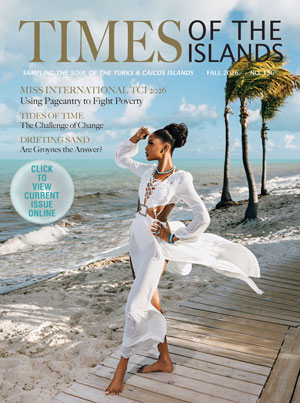
On the Cover
Local photographer Watsonne Morency (www.watsonnephotography.com) took to The Shore Club to capture this image of Miss Turks & Caicos International 2026 Adesha Gustave.
Our Sponsors


Leave a Reply