

Creature Feature
Now You See Them, Now You Don’t
The Bahamian Swallowtail
By Bill Rhodes
I have a confession to make — since I was a boy, I’ve been fascinated with butterflies and their night-flying brethren, moths. So wherever I travel, I always stop to notice the colorful butterflies flying past or sipping nectar from a flower. We are fortunate in the Turks & Caicos in having a variety to spot year-round — and none are showier and more exciting to see than the Bahamian Swallowtail.
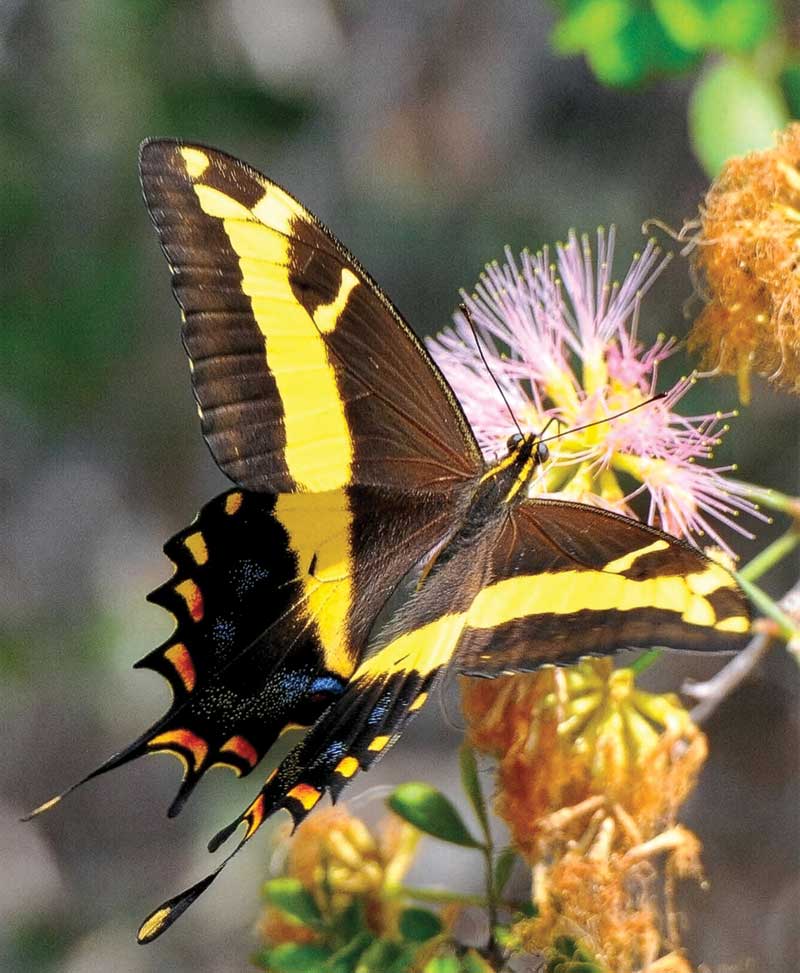
The brilliantly colored Bahamian Swallowtail is typically seen flying in sea-level scrub and tropical hardwood hammocks, visiting the flowering plants found there.
Despite its common name, the Bahamian Swallowtail, Papilio andraemon (sometimes referred to as Heraclides andraemon), is found on several islands in the Caribbean, including the Turks & Caicos. It is a large butterfly, with a wingspan that typically reaches between 3 and 5 inches. The colors on their upper side contrast drastically with the underside; the upper surface is chocolate-brown to black bisected by a yellow horizontal band, while underneath, the wings reveal a complex pattern of chestnut-red and blue patches and intricate silver-gray scaling against a yellow background. As its common name implies, each hindwing is graced with a short “tail.”
Within the Turks & Caicos, the Bahamian Swallowtail is primarily restricted to the Caicos Islands and not found on the smaller, drier Turks Islands.This is due to the abundance, (or lack of) its larval host plants. Their caterpillars feed on plants in the citrus (Rutaceae) family and aside from those planted for landscaping or agricultural purposes, these include native plants such as wild lime (Zanthoxylum fagara) and torchwood (Amyris elemifera).
Flying in sea-level scrub and tropical hardwood hammocks, the butterflies are often seen visiting the abundant flowering plants found in landscapes. Where they have “gone native” though, the dense, low-lying forests provide the perfect microclimate: protection from the wind and a steady supply of nectar-rich wildflowers. The seemingly sporadic appearance of the butterfly flying in abundance can be confusing. While found year-round, they are often first seen during the late spring and early summer, after which numbers of flying adults dwindle until they reappear in mid-summer, fall off, and then reappear in the early to late fall.
This is because the butterfly’s life history is so closely linked to the availability of its larval foodplants. Just as plant growth is distinctly influenced by the seasonal nature of the Islands’ rainy and dry periods, so is the swallowtail’s life cycle.
They produce three distinct broods, or generations, per year. The spring brood (March to May) is the first and typically emerges with the rising temperatures of spring.They often appear just as the wild lime and torchwood begin their first flush of new growth. The summer brood (June to August) is often the most prolific as larval host plants, fueled by the early summer rains, allow more caterpillars to eat and consequently grow rapidly. During this period, the butterflies are highly visible, frequently seen darting through gardens to visit flowering plants and flying along the edges of the “bush.”
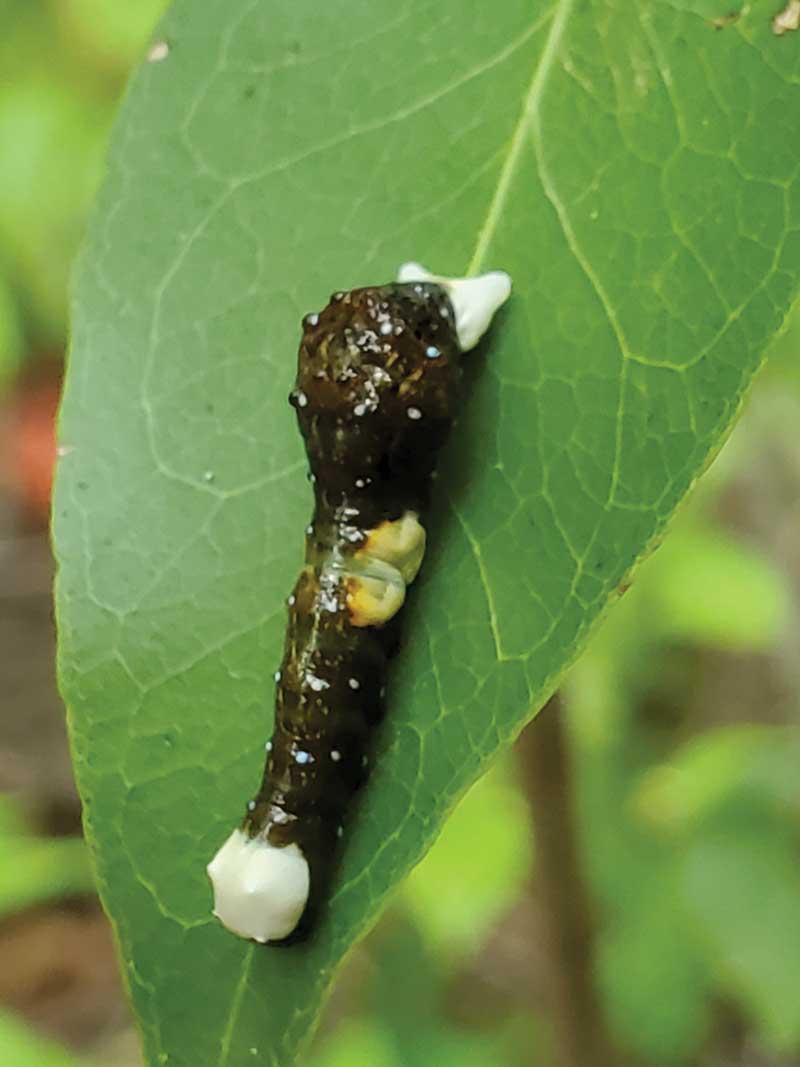
The Bahamian Swallowtail larvae resemble bird droppings in their early, very vulnerable stages and also sport a “forked tongue.”
The autumn brood (September to November) is the final brood of the year and aligns with the peak of the hurricane season and transition into the cooler, drier months. This generation is crucial for the species’ survival. Like all butterflies, the Bahamian Swallowtail goes through four distinct life stages: egg, larva (or caterpillar), chrysalis (also called pupa), and finally, winged adult.
As the environment becomes less hospitable, many of the pupae (chrysalises) from this brood enter a state of diapause or slowed development waiting for the following spring to emerge. They essentially “stop” or at least delay the clock, so that the first brood of the year can emerge the following spring when their food plants begin to sprout new leaves.
Of course, predators like anoles, other insects, and birds are eager to take advantage of the slow moving and nutritious larval swallowtails as a convenient food source. Swallowtail butterflies in general, and the Bahamian Swallowtail specifically, have developed unique defenses to hopefully avoid becoming a meal. The larvae resemble bird droppings in their early, very vulnerable stages to hide from and deter predators, and also sport a “forked tongue.” known as an osmeterium, which they extrude when threatened. This orange-colored Y-shaped organ emerges from a slit just behind the head, looking very much like a snake’s forked tongue. If that’s not deterrent enough, it also emits a rancid odor. The combination of noxious chemical and snakelike appearance often is enough to scare off the would-be diner.
While the Bahamian Swallowtail is currently considered secure globally, its status in the TCI requires constant monitoring. Habitat loss due to coastal development and the removal of “scrub” (which many see as weeds, but butterflies see as home) pose the greatest risks. Protecting native torchwood hammocks is essential for their survival, and encouraging the planting of native Rutaceae in local landscaping can provide a vital bridge for their three annual broods — ensuring this bold, beautiful swallowtail remains a permanent fixture here.
What's Inside The Latest Edition?

On the Cover
Local photographer Watsonne Morency (www.watsonnephotography.com) took to The Shore Club to capture this image of Miss Turks & Caicos International 2026 Adesha Gustave.
Our Sponsors


Leave a Reply