

Natural History
One Backyard at a Time
Rewilding with bird allies.
Story & Photos By Kathleen McNary, BSc., ALM, PhD
In 1960, Rachel Carson inspired the fledgling North American environmental movement with her groundbreaking book Silent Spring. In that work, she hypothesized that the careless degradation of the environment by humans, including the use of toxic chemicals to rid backyards and agricultural fields of insects, would cause the mass mortality of birds and lead to a world bereft of birdsong.
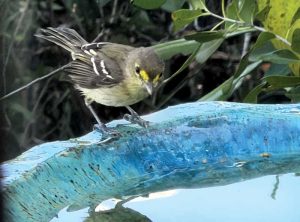
The endemic Thick-billed vireo, known locally as “chick-to-will-ee,” depends on native fruits and seeds for survival and also fills TCI’s airwaves with its distinctive song from which its local name is derived.
More than sixty-five years have passed since the publication of Carson’s masterpiece, and some conservation wins have occurred in the interim. Most countries (unfortunately, not including the Turks & Caicos Islands) have banned the dangerous pesticides known to be persistent organic pollutants (or POPs), which bioaccumulate up food webs, leading to the demise of not only targeted insects, but also the other organisms, including birds, who feed on them. Other positive changes, such as the passage of the Clean Air and Clean Water Acts in the United States and similar legislation elsewhere, have allowed for the recovery of some bird populations, such as the American Bald Eagle, and TCI natives, including American Kestrel and Osprey. However, the continued large-scale land clearance and application of “safe” pesticides and herbicides for agricultural and landscaping applications has had far-reaching and devastating effects on the entire ecosphere because. As John Muir, the founder of the Sierra Club, observed more than a century ago, if one tugs at one thread in Nature, all of existence may unravel.
Carson’s intuition was unfortunately prophetic and in 2019, Kenneth Rosenberg of Cornell University and several of his colleagues conducted a large-scale assessment of North American bird populations. They discovered that since 1970, human activities have resulted in the loss of three-billion or one-third of all birds from North American skies. The demise of birds represents not only a tragic loss of music and beauty from the world but also results in the catastrophic disintegration of the intricate tapestries of biodiversity within which they are woven. Fortunately, the opposite is also true. As birds return to rewilding Land, floral species richness also increases, which in turn facilitates the return of other plant and animal species. In fact, by introducing and dispersing seeds and serving as pollinators, birds can dramatically accelerate the rate at which devastated Land recovers. One study found that birds increased species richness and abundance by five to eight times. Therefore, making one’s backyard welcoming to birds can reap rewilding rewards, allowing Land to build habitats for all beings and to recover from disturbance more rapidly.
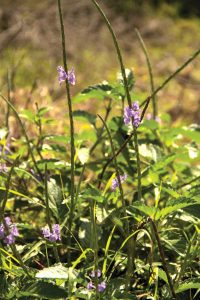
As an abundant nectar producer, Blue Rat-tail provides critical food resources for TCI’s hummingbirds as well as other important pollinators.
Like all living organisms, birds require fundamental resources for survival, including access to fresh water, shelter, food, and the necessary tools for reproduction, such as nesting materials. In TCI, the scarcity of fresh water represents one of the biggest challenges for birds. Preparing a space for an outdoor water bowl or birdbath will not only entice birds onto Land but will help them to survive the prolonged periods of drought that periodically occur. Note that birdbaths and water bowls must be kept impeccably clean to avoid spreading disease. Water should be changed daily, with the container also regularly thoroughly washed and disinfected. A blue or turquoise shallow ceramic dish works well for this purpose, as the color seems to attract birds, signaling a water supply. Providing areas for perching and shelter nearby enhances accessibility.
When choosing plants to add to rewilding Land, selecting native floral species that provide services for and attract birds will pay the greatest dividends in the long-term because of the critical ecosystem services that birds provide. Numerous native floral species, including trees, shrubs, and herbaceous plants, provide critical structures for roosting and nesting, food resources, and nesting materials. For example, elegant Gumbo Limbo trees Bursera simaruba are quick growing, have attractive reddish bark, and produce abundant fruit that is a favorite of the endemic subspecies Thick-billed Vireo Vireo crassirostris stalagmium.
Plants that produce abundant nectar when flowering are critical for some species, such as Bananaquits Coereba bahamensis and Bahama Hummingbirds Nesophlox evelynae. Although common in the Bahamas and TCI, these birds are only found in the Lucayan Archipelago (which includes TCI and the Bahamas), making them vulnerable to any habitat losses. Plants that are particularly desirable to these birds include the herbaceous species Blue Rat Tail Stachytarpheta jamaicensis, and the woody shrub known locally as “Strong Back” Bourreria ovata. Strong Back’s berries are also a favorite food of the Bahama Mockingbird Mimus gundlachii.
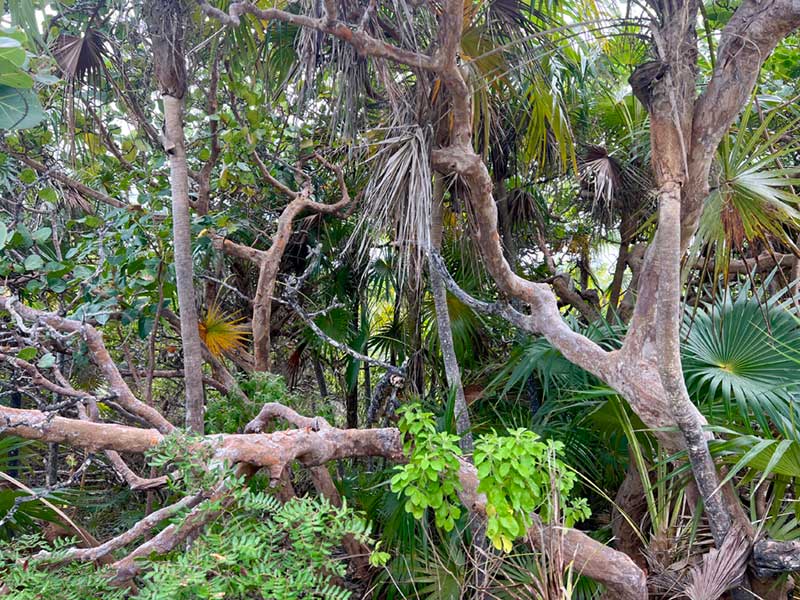
Ann Morgen, a former professional photographer and frequent visitor to North Caicos, took this image of a patch of Land on TCI’s “Garden Island.” Look closely and see how many different plants can be seen in this small sampling.
Of course, the best way to protect and attract TCI birds is by not destroying or poisoning their habitats in the first place. Toxic maintenance chemicals should never be applied to landscapes where birds are present, and when removing plants to make room for human spaces, it pays to be mindful of the plants being displaced. Plant removal should be kept to the absolute minimum required for building projects, and Land should be surveyed before any removal takes place to ensure that critical habitats for birds, such as nesting areas, are not disturbed during the construction process. Many plants, including all those mentioned in this article, can be easily transplanted. No plants should be removed simply because they are inconvenient for humans.
For example, pigeons and doves, such as the White-Crowned Pigeon Patagioenas leucocephala, Mourning Dove Zenaida macroura, and White-winged Dove Zenaida asiatica, depend heavily on the succulent fruit of the Poisonwood Metopium toxiferum tree, which provides both nutrition and water for these birds. Although some humans may have an allergic skin reaction when coming in contact with this tree, which is a close relative of the Mango Mangifera indica, the indiscriminate removal of Poisonwood trees has resulted in significant declines in pigeon and dove populations. Therefore, these trees should be allowed to flourish whenever possible, particularly when they are not located adjacent to footpaths and other areas frequented by humans.
Although humans have developed economic systems that allow us property rights to Land in exchange for currency, in the natural world, the Earth does not belong to us. We, along with all other beings, belong to the Earth, which means learning to equitably share with those who also call our backyards home. In doing so, we may not only help to restore our planet to a semblance of ecological integrity but also ensure that spring and every other season of the year will always be filled with the beauty of birdsong.
Kathleen McNary (BSc. ALM, PhD) is a dual US/TCI citizen and has worked within environment-related fields for more than 35 years. She has designed, coordinated, and implemented more than 80 environmental impact assessments and independent research projects and is also the author of several publications including The Flowers of the Bahamas and Turks and Caicos Islands (2003) and “A Year of Rewilding: A co-operative scholarly interspecies narrative to deconstruct orthodox conservation science toward a truly restorative ecology” (PhD Dissertation, 2025). Her current research focuses on transforming traditional conservation science through fostering reciprocal relationships between people and their environments.
What's Inside The Latest Edition?

On the Cover
Local photographer Watsonne Morency (www.watsonnephotography.com) took to The Shore Club to capture this image of Miss Turks & Caicos International 2026 Adesha Gustave.
Our Sponsors


Leave a Reply