

Features
Pride in Preservation?
Images of the heritage buildings of North and Middle Caicos
Story & Photos By Ann Morgen
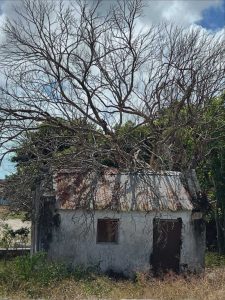
When the settlement of Kew, North Caicos became the administrative center of the Caicos Islands, this was the original Government Administrative Building.
I have had an abiding interest in the diminutive historic buildings built by former slaves that dot the Caicos Islands. I have found these buildings—sometimes no larger than a hut—in the settlements of Bottle Creek and Kew on North Caicos, and Lorimers and Bambarra in Middle Caicos. Some stand empty, some are occupied. In their simplicity and the patina of a century of sun, salt, and hurricanes, they take on an artist’s palette.
With each passing year there are fewer of these buildings standing. They are often removed to make way for something else. These remnants of the past that are part of the cultural heritage of the Turks & Caicos Islands are dwindling before our eyes.
There are a great many buildings of distinct and unique character dotting the islands of North and Middle Caicos. These were built by Islanders after the Emancipation Act of 1834 when enslaved peoples were freed in the British colonies.
These buildings stand with both dignity and integrity. The latter, because they have stood the test of time through virtually two centuries of hurricanes, and the former, because they serve to remind us of the resilience and fortitude of the people who forged their futures in the face of great adversity. Their descendants live here today, very often on the same land alongside these homesteads.
Between the 1840s and the early 1900s, people began settling on small plots of land. The settlements of Kew and Bottle Creek were established. People lived independently by farming, fishing, and trade with Haiti and other nearby islands.
With little money and few imported materials available, homes were necessarily made with local materials. Houses were built from limestone blocks, conch shells, and thatched roofs on the islands of North Caicos and Middle Caicos. This type of construction was typical working class architecture on the Caicos Islands in the 19th century. The buildings can be viewed as monuments to a resilient and resourceful people.
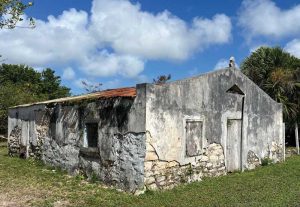
This heritage building was the Church of God of Prophecy in Kew, North Caicos, circa 1930.
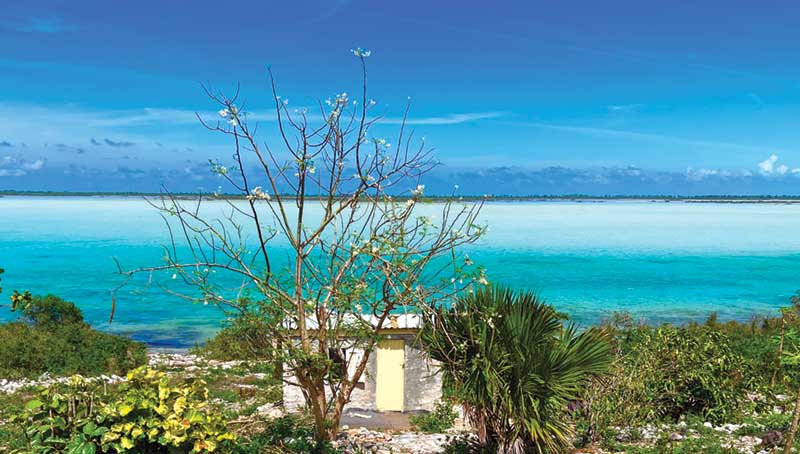
This tiny building overlooks Bottle Creek, North Caicos. The settlement’s name is said to be derived from this large tidal creek, that locals say is shaped like a bottle.
As imported building materials were extremely scarce and expensive, the people developed a distinctive local construction method using limestone and conch shells. The use of conch shells was not random: it had a practical chemical purpose. Conch shells are composed mostly of calcium carbonate, the same material found in limestone. When shells are burned in a simple kiln or fire, they produce quick lime, which could be mixed with sand and water to create lime mortar. Broken shell fragments were mixed directly into the mortar or plaster. This strengthened the material and reduced cracking. Conch was a natural aggregate.
Conch was also a major food source so shells accumulated in large piles near settlements and were readily available building material. This construction technique produced durable masonry that could withstand salt air and hurricanes better than wood structures.
The buildings were simple affairs for practical reasons. The walls, somewhat irregular blocks of locally quarried, coral limestone, could be 12 to 18 inches thick set in lime mortar containing crushed shell. The outer surface was originally lime plastered and white washed. The floors were primarily packed earth or lime plaster. The roof was made of wooden frame and thatch and later replaced by corrugated metal. Windows were small openings with shutters to guard against hurricanes, heat, and mosquitoes. The average size of these buildings was usually one or two rooms.
This Masonry style was standard village building technique in the Caicos during the 19th century. Whereas earlier cotton plantation buildings built in the late 1700s by Loyalists usually have more cut limestone blocks and a more formal symmetry. An example can be found at Wade’s Green Plantation in North Caicos.
Of the two settlements previously mentioned—Bottle Creek and Kew on North Caicos—Kew eventually became the first administrative center of the Caicos Islands. (The current center of administration for the district is in Bottle Creek.) Conch Bar and Bambarra are located in Middle Caicos and are among the oldest native settlements on the Caicos Islands. Bambarra has strong traditions linking it to freed African shipwreck survivors. Lorimers and other small settlements were farming communities formed on land once connected to plantations.
Many ruins and original homes remaining today provide an historical window on the cultural heritage of the original “Belongers” and certainly enhance the beauty and history of the Turks & Caicos Islands.
What's Inside The Latest Edition?
On the Cover
Local photographer Watsonne Morency (www.watsonnephotography.com) took to The Shore Club to capture this image of Miss Turks & Caicos International 2026 Adesha Gustave.
Our Sponsors


Leave a Reply