

Astrolabe
Run Aground
Shipwrecks of the Turks & Caicos Islands — The Turks Islands (1837 – 1840)
By James Jenney, Director of Research, The Bahamas Lost Ship Project
Editor’s note: What struck me in reading this installment was the significance of an “Unidentified” ship lost at sea, and how common this situation had been. How many weeks, months, or years did family and friends wait to find out what happened to their dear ones who vanished into the sea? Fascinating are the few clues left behind and the diligence and investigative work required for researchers to try to discover the identity of these missing vessels and their captain and crew, even to this day.
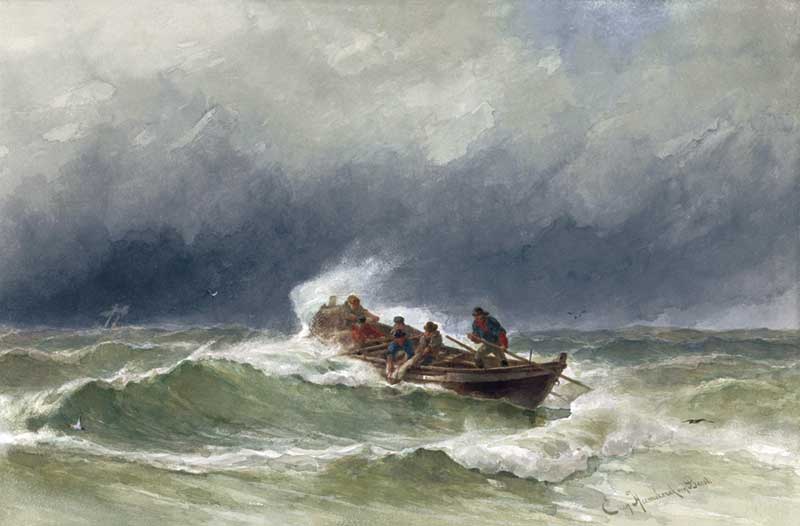
This Dutch watercolor painting “Rescue at Sea,” by Jacob Eduard van Heemskerck van Beest depicts a six-man rowboat pulling a seaman abroad in the storm-blown open sea.
April 30, 1837 — ELIZA ANN
On April 30, 1837, the American owned Brig Eliza Ann ended her final voyage when cast away on Grand Key, Turks Island. Although it was not mentioned in any of the accounts of her loss, it was likely that the cause of her disaster was weather related as she was mentioned as “cast away,” which usually implies weather as a major factor in the disaster. According to the account in the Philadelphia Daily Pennsylvanian, “Capt. Goodrich, of brig Canton, at New York, reports that the brig Eliza Ann, Vincent, of and from Boston, bound to Cape Hayti, was lost on Grand Key on the 30th of April — vessel a total loss; captain, crew and part of the cargo saved.” Other accounts indicated that the cargo that was saved from the wreck was damaged, suggesting the severity of the stranding. No further information has been located relative to any other post-disaster operations.
June 28, 1837 — MARY ANN
Carrying a load of lumber and food, the Canadian brig Mary Ann, of St. John, New Brunswick, Canada, was southbound for an unspecified port in Santo Domingo when she ran into trouble on the night of June 28. According to the account from the New York Evening Post, “Shipwreck — The British brig Mary Ann, of and from St. John, New Brunswick for St. Domingo, with a cargo of fish, pork and lumber, was lost on the Square Handkerchief, near Turks Island, on the night of the 28th June. The captain and crew arrived at Turks Island on the 30th and several small vessels sailed that day for the wreck, to save what they could.” There was no report of the success or failure of the salvagers at the site.
November 29, 1837 — GENERAL COFFIN
After the Haitian Revolution (which ended in 1804) the country shifted from plantation-based agriculture to a more subsistence-based system but that did not mean that they did not need to import particular products. New Brunswick accepted the role of a major supplier of timber and ships to Haiti, particularly after 1815. In return they imported sugar and rum from that island country. The brig General Coffin was just one vessel employed in that trade when she was lost in her way southbound. According to the account in the Baltimore Patriot, “The brig General Coffin, Payson, of St. Johns, NS [a mistake that should have read St. John, New Brunswick], bound to Jeremie was wrecked on the NE end of Grand Turk on the last of November. Part of the cargo and crew saved.” This vessel was probably named after General John Coffin, a prominent figure in New Brunswick, Canada, who had been a military officer, businessman, politician, and judge until his death in 1838.
December 17, 1837 — CONSUL
Although first reported lost on Cayco Island [Caicos], the American newspapers quickly updated the story indicating that the final voyage of the schooner Consul actually ended on the northeast reef off Grand Turk Island. The New York Commercial Advertiser reported, “The schooner Consul, Simpson, of Sullivan, from New York bound to Belize, Honduras, was wrecked on the 17th of December, on the N.E. end of Grand Turk; part of her cargo saved — crew narrowly escaped with their lives — Capt. S. has arrived at Baltimore in the British schooner Brilliant.” That the report indicated that the crew narrowly escaped with their lives suggests that the incident was relatively intense for all of the survivors. There is no indication of the nature of the cargo carried or to what degree salvage was successful.
April 30, 1838 — ALEXANDER
According to the report in the New York Commercial Advertiser of May 25, “The brig Alexander, Covell, 12 days from Norfolk for Kingston, Jam. went on shore on Grand Key on the 30th April, loaded with flour — most of the cargo saved in a damaged state — vessel a total loss — captain and crew saved.” Although not confirmed, the vessel is believed to be the one documented above, launched in Pittston, ME in 1826. A rival newspaper, the New York Shipping & Commercial List, carried a similar story on the following day but named the brig Alexandria. Other reports agreed with the original account — the news was brought to New York by the British schooner Spartan when it returned from a voyage to Antigua. No other details have been found and no word of further salvage of the wreck.
July 3, 1838 — LOUISA ANN
An article in the Charleston Courier read as follows, “[Correspondence of the Journal of Commerce] — Turks Island, July 11 — The British schooner Louisa Ann, Amos Cook, late master, and owned in Jamaica, was lost on a reef off the east side of this island on Tuesday night the 3rd inst. on her passage from St. Johns, New Brunswick to Montego Bay, Jamaica; captain and crew all saved; also part of the cargo, principally damaged, which consisted of dry and pickled fish, beef and pork, lumber and shingles, and oil.” Probably the most mysterious part of this correspondence is that it mentions Amos Cook as the late master but then states that the captain and crew were all saved. Probably what that alludes to is that Cook was lost before the disaster took place, which could also be the reason for the navigational error. Quite often this would happen when a master would be lost during a voyage and command devolved to a mate or ordinary crewman who may or may not have had the skill to navigate the vessel safely to port. In this instance, that is conjecture, but it fits the evidence presented.
July 17, 1838 — FASQUE
The initial report of the loss of this vessel appeared in the New York Commercial Advertiser in August of 1838 and read as follows, “The ship Vistula, arrived at this port last night, from Turks Islands, has on board six of the crew of the British ship Fasque, of and from Liverpool, and last from St. Johns, for Jamaica. The Fasque is reported to have been lost on the night of the 3rd of July on Grand Turk — the crew and part of the cargo was saved, but the vessel is a total loss.” Other newspapers provided a similar account but with a different date. The New York Commercial Advertiser on October 10 corrected the error with the following report, “ . . . The bark Fasque, James Forde, master, from Liverpool bound to Jamaica, was wrecked on the N.E. side of these islands on the 17th July. The master has arrived at this port.” Although it is likely that there was further salvage performed at the wreck site, there is no further detail provided.
July 29, 1840 — UNIDENTIFIED
When a vessel is lost with all hands and in as remote an area as the Turks & Caicos Islands, the chance of identifying the vessel or details about her are greatly diminished. Such was the case of this Unidentified schooner. The New York Shipping & Commercial List reported the following, “A British schooner from Grenada was cast away on Grand Key on the 29th ult.; vessel a total loss; captain, crew, sails and rigging saved.”
To try and identify the wreck requires using every clue offered. The first check was to look at vessels traveling to and from the island of Grenada. Those specifics or even statistics relative to their exports are not available. Digging deeper into the mystery required a knowledge of the type of cargo (if she was carrying cargo) that was being exported from Grenada. Formerly, the island had survived, as many smaller Caribbean islands did, by exporting sugar and rum to northern ports. With the abolition of slavery in the 1830s, these two industries were affected in every place that the plantation system of agriculture was predominate. In many areas that system ceased to exist. Grenada was no exception but was starting to recover in the 1840s with the exportation of nutmeg (in 1843) and cocoa. The shipwreck accounts do not indicate the salvage of cargo or rescue of the crew, nor do they mention the type of cargo that was aboard. We could guess that the ship’s papers were rescued and told of her port of departure, but these papers would surely have her identity noted. It seems that we are left with the conclusion that her cargo was identified (likely to be cocoa) and that her design and rigging led to her identification as a British vessel. More than that we do not know.
September 29, 1840 — HIRAM
Not much is known about the schooner Hiram itself probably because it was a relatively small vessel for a commercial schooner. The announcement of her loss appeared in the Disasters section of the New York Shipping & Commercial List for October 21 which read as follows: “Schooner Hiram, Doane, from Halifax, N.S. for Falmouth, Jam. was wrecked and totally lost on the N.E. reef of the Grand Turk during a heavy squall 29th ult. In making an effort to leave the wreck, their boat was capsized, and their oars lost. The crew reached the land in safety, a distance of five miles, among the reefs, with pieces of the wreck serving as paddles. A small amount of the cargo was saved.”
One newspaper reported that the schooner was lost at a distance of four miles from shore. It is possible that this was a typesetting error but that is not confirmed. In either case the focus of the account was the loss and the ordeal that the crew went through to make it ashore safely. The assorted cargo was most likely a combination of lumber and foodstuffs which was the norm for vessels southbound to Jamaica.
September 30, 1840 — UNIDENTIFIED
Although it is not unusual for a wrecked ship to be unidentified when the crew are lost and the vessel destroyed; it is an entirely different case when there are survivors saved from that ship. The newspaper report, notably found only in the New York Shipping & Commercial List, reads as follows, “Schooner Tower, Barker, arrived here from Turks Island, reports that a British brig belonging to Halifax, N.S. from Demerara, was totally lost at Turks Island on the 3rd inst. Crew saved.” It could be deduced that the brig was homeward bound to Halifax but that is not confirmed. By not being mentioned that any cargo was saved it is likely that she was either not carrying any or that it was destroyed. Typical cargos from Demerara at the time were either sugar, rum, molasses, or some combination of those. This port also shipped sought-after logwood and dyewood to manufacturing ports around the world.
December 18, 1840 — ELIZA
Details of the loss of the British brig Eliza came from a letter from Walter R. Jones, Esq., Secretary of the Board of Underwriters in New York which was printed in the New York Commercial Advertiser of January 18, 1841, which read, “Turks Island, 19th December 1840. Walter R. Jones, Esq., Secretary of the Board of Underwriters, New York. We beg to inform you that the British brig E
liza, Burrows, late master, was wrecked last night on a reef off the east part of this island, in her passage from Quebec to Kingston, Jamaica, laden with pork, beef, flour, salmon, wine, &c. &c., part of which has been saved, but in consequence of the vessel sinking, we presume a large portion of the cargo will be lost. The vessel and cargo are owned by Harvey & Darrell, of Kingston, Jamaica. The former gentleman with his family were passengers on board when she struck.” No report of any further action taken to salvage materials from the wreck has been found.
James Jenney is the director of research for the Bahamas Lost Ships Project, which is working in collaboration with the Bahamas Maritime Museum and Carl Allen of Allen Explorations. For more information, visit https://www.bahamasmaritimemuseum.com.
What's Inside The Latest Edition?

On the Cover
Local photographer Watsonne Morency (www.watsonnephotography.com) took to The Shore Club to capture this image of Miss Turks & Caicos International 2026 Adesha Gustave.
Our Sponsors


Leave a Reply