

Features
A Looming Crisis
Will rock groynes protruding from Grace Bay Beach be allowed?
By Ben Stubenberg
One day, not far off, we might be standing on a tiny patch of white sand looking out upon Grace Bay and ask, “How did we go so wrong?”
The pristine Grace Bay we know and love faces the prospect of being scarred and carved up by long lines of rocks extending out from the sandy shore that are called groynes. The ugliness of the word matches the hideousness of the structure. Instead of marveling at a vast expanse of mesmerizing, unspoiled turquoise water that stirs the soul, we could be looking at a series of confined rectangular spaces chopping up the beach.
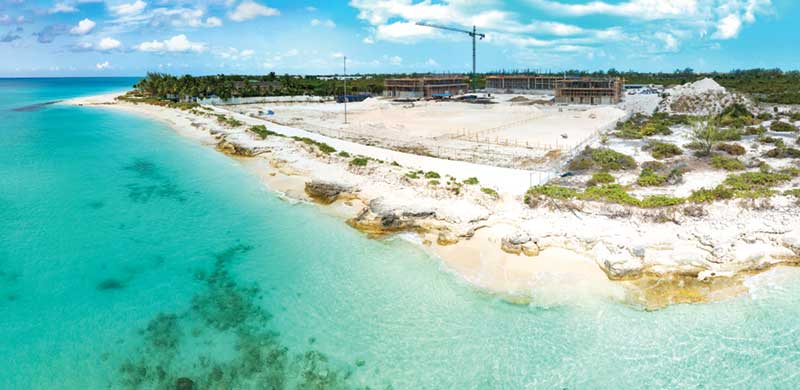
These August 2026 images show the extensive beach erosion in front of the under-construction Kempinski resort on the far eastern end of Grace Bay Beach.
Sitting before the Turks & Caicos Islands Planning Board for consideration is a highly technical Environmental Impact Assessment (EIA) commissioned by Blue Conch Holdings. Blue Conch is the developer for the new Kempinski Grace Bay resort under construction. The EIA proposes that three T-shaped rock groynes be placed in front of the resort to restore the beach that has eroded away.
These groynes, if approved, would extend 57, 53, and 42 meters out into Grace Bay just west of Coral House. The idea is for the groynes to trap some of the sand moving east to west along the shore with the prevailing current. But mainly the groynes are also designed to be “nourished” from time to time to hold sand brought in from somewhere else by barge to form a beach.
Blue Conch’s concern is understandable. The beach in front of the property began seriously eroding around 2021 to the point where the sand has all but disappeared, leaving only limestone rocks.
The EIA places much of the blame for the erosion of the beach in front of the Kempinski resort on the groyne constructed years ago in front of Coral House. That groyne, according to the EIA, has created a “shadow zone” in front of Kempinsky resort. Essentially, the Coral House groyne allows sand to move past the Kempinsky resort, leaving Kempinski with almost nothing.
There may be merit to this assessment. Groynes that trap sand on the “upward drift” side create erosion that affects beach sand on the “downward drift” side of the structure. In other words, one side of the rock line gets sand at the expense of the other side.
Other factors can contribute to beach erosion. These include changing shore dynamics of the smaller cays to the east of Providenciales, storms, and Mother Nature’s natural ebb and flow. Whatever causes the erosion, the EIA remedy calls for an intrusion of rock groynes into the Princess Alexandra National Park that encompasses Grace Bay.
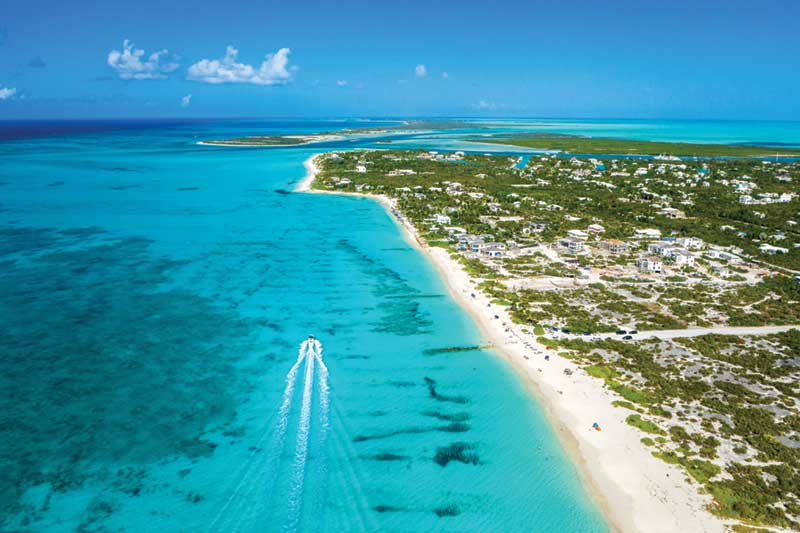
This was Leeward Beach in 2020 before extensive construction of groynes. Note the width of the sandy beach.
The question now before the TCI Planning Board is whether to allow rock groynes that may alter the nature of Grace Bay for the benefit of one developer. The developer bought the land only—not the ocean.
It is fair to ask: Why should the TCI Government give a developer additional rights to build structures into the Princess Alexandra National Park that Turks & Caicos Islanders have enjoyed for 200 years?
And if one developer can install groynes, does that open the door for other resorts further east along Grace Bay to build their own groynes to grab some “downward drift” sand for themselves? It is not hard to imagine the visual pollution of multiple groynes degrading the quality of Grace Bay, a national treasure that brings in a half million tourists every year and hundreds of millions of dollars in revenue. The potential financial impact on TCI’s economic engine cannot be understated.
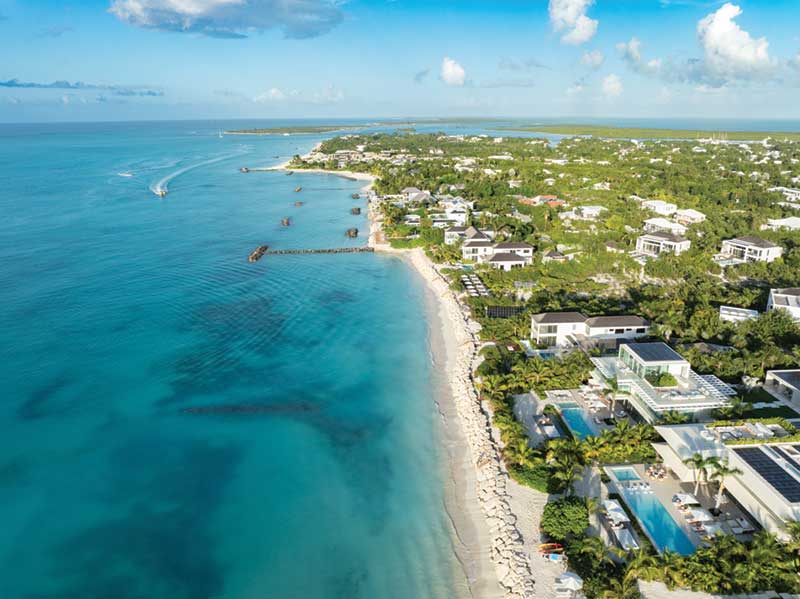
This image shows Leeward Beach in early 2026, with extensive erosion of the beach, revealing the rocky coastline.
The consequences of allowing the groyne proposal to go forward are potentially devastating on many levels and may last for decades, if not centuries to come. Big rocks don’t wash away easily. Indeed, one need look no further than the series of rock groynes extending out from the Leeward Beach to see the consequences. As the beach there eroded, the villa owners spent millions of dollars to install groynes to salvage some beach sand in front of their properties.
But did the unsightly Leeward groynes do any good? The aerial pictures vividly tell the story. The once grand and beautiful beach that ran along Leeward remains severely eroded and has turned into an eyesore. Some parts are only limestone rocks and impassable even at low tide.
This impact should have come as no surprise. The effectiveness of groynes in restoring beach is fraught with scientific controversy. Prominent American coastal geologists, notably Dr. Orrin Pilkey, former professor at Duke University, have documented the negative impact of groynes. In the academic journal Coastal Care, Dr. Pilkey and other coastal geologists wrote:
“There is nothing experimental about groins. It is clear that on a shoreline where sand is transported laterally, groins will always cause erosion. The only questions are where and when will this erosion occur.”
And yet, despite universal agreement on Grace Bay’s entrancing beauty, the powers-that-be are about to make a crucial decision that could either preserve it or wreck it for generations to come. Paradise, once destroyed, does not easily return. One need look no further than the Garden of Eden.
It is not too late for TCI to spare itself from a horrible wound. The Planning Board can reject the groyne installation proposal.
At the same time, the Planning Board or another TCI government agency must implement an independent beach erosion study. First, to ascertain the precise causes of beach erosion in Leeward and Grace Bay. Second, to assess the impact of the groynes already in place. Third, to determine the best course of action going forward that could include removing the groynes extending out from Leeward Beach.
The goal is as simple as it is straightforward: Preserve Grace Bay’s long white sand beaches and gorgeous hues of blue water for Turks & Caicos Islanders, resorts, and visitors without a collection of groynes to ruin it.
Ben Stubenberg is a local author and feature writer for Times of the Islands who covers TCI history and current events. He is also the co-founder of the annual Turks & Caicos “Race for the Conch” Eco-SeaSwim, a stakeholder opposed to groynes in Grace Bay.
What's Inside The Latest Edition?

On the Cover
Local photographer Watsonne Morency (www.watsonnephotography.com) took to The Shore Club to capture this image of Miss Turks & Caicos International 2026 Adesha Gustave.
Our Sponsors


Leave a Reply