

Astrolabe
Buried “Treasure”
Mining bat guano on East Caicos.
By Jeff Dodge
Sometime in the 1870s, John Reynolds discovered that caves on the northwest side of East Caicos contained buried treasure. Not pirate treasure, but valuable none the less. What Reynolds found was that these caves contained guano (or “cave earth” as some called it). This rich fertilizer, left behind by bats that inhabited the caves, was exported to the sugar cane plantations in Jamaica.
John Reynolds and his wife moved to the Turks & Caicos Islands from Ireland in or about 1865. He soon entered the business of salt production on South Caicos, eventually becoming the owner of the largest salina at East Harbour (now Cockburn Harbour). In 1881 or 1882, Reynolds sold his South Caicos salt property to Alfred Stubbs so he could focus his attention on the East Caicos property he had acquired in 1871.
In 1882 Reynolds decided to extract (mine) and export guano from the caves on his property. He was no doubt encouraged by the fact that the firm of Frith & Murphy had been successfully exporting guano from Conch Bar Cave on Middle Caicos for several years.
The caves
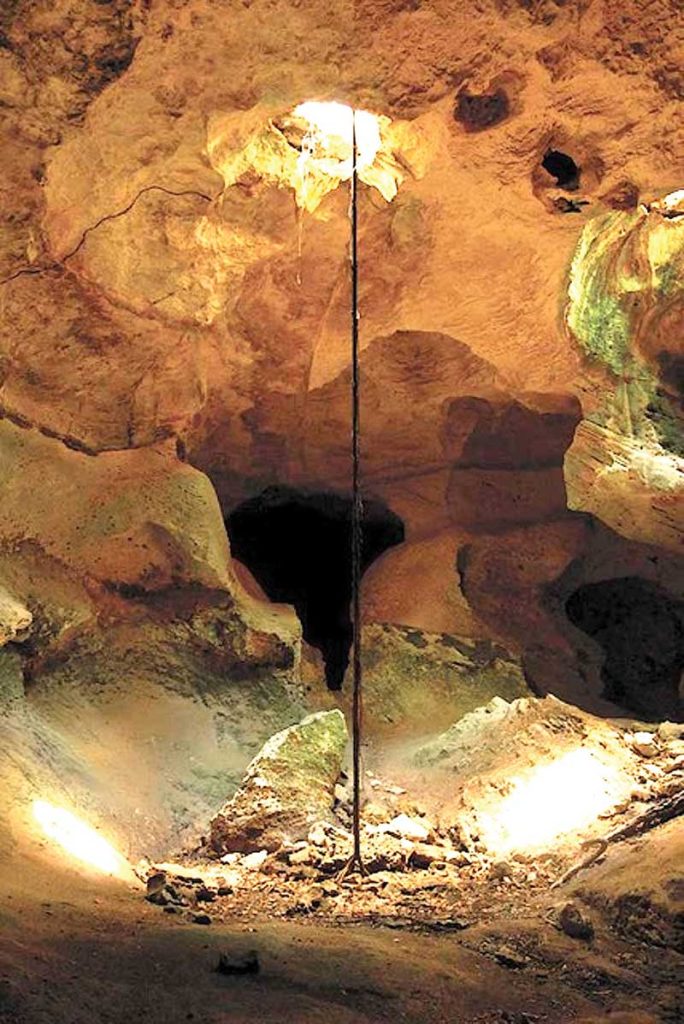
A fig tree root grows down from a natural opening at Stubb’s Guano Cave. The year “1883” is inscribed on a wall of this cave.
Reynolds discovered three caves on his property that contained bat guano. (There were at least four species of bats found living in caves on the Caicos Islands.) Two caves were within half a mile of Jacksonville Creek. They are known as the Stubb’s Guano Cave (a.k.a. Cave New No. 1) and Cave Old No. 2. The third cave, a mile beyond Old No. 2, was Edison’s Cathedral Cave on Cape Comete Hill.
Stubb’s Guano Cave is a dry cave. The date “1883” is inscribed on a wall inside this cave—a testament to the guano mining era. The cave contains petroglyphs, stone carvings, and other signs of early Lucayan presence. These relics have been the subject of extensive research and reporting following Theodoor de Booy’s archaeological visit to the Caicos Islands in 1912.
Cave Old No. 2 has a water pool at one end. It was close to Stubb’s Guano Cave, but the two were not connected.
Edison’s Cathedral Cave, located at Cape Comete Hill, is impressive in size having ceilings over 27 feet high. It is largely flooded and apparently required pumping in order to access the guano it contained. Machinery from the guano mining days can still be found inside.
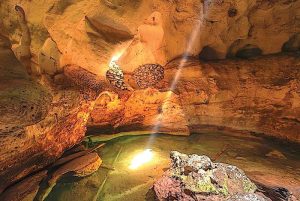
This recent photo inside Edison’s Cathedral Cave (a.k.a. Cape Comete Cave) shows its natural beauty and complexity.
Tramway system
To export guano from the caves on East Caicos, Reynolds had to transport it from the caves to navigable waters. To facilitate this, he built a pier at Jacksonville Creek and later, a tramway system consisting of 9 cars or carts pulled by mules along steel tracks. The 1½ mile long tramway system began at the pier at Jacksonville Creek, passed Stubb’s Guano Cave and Cave Old No. 2, crossed a swamp on a stone causeway, and terminated at Edison’s Cathedral Cave at Cape Comete Hill.
In 1888, Reynolds advertised in the Bermuda Gazette that his East Caicos holdings, including a 1½ mile long iron tramway system, were for sale or lease. The ad went on to say the tramway had been used for just 3 months suggesting it didn’t become operational until early 1888.
A questionably timed investment
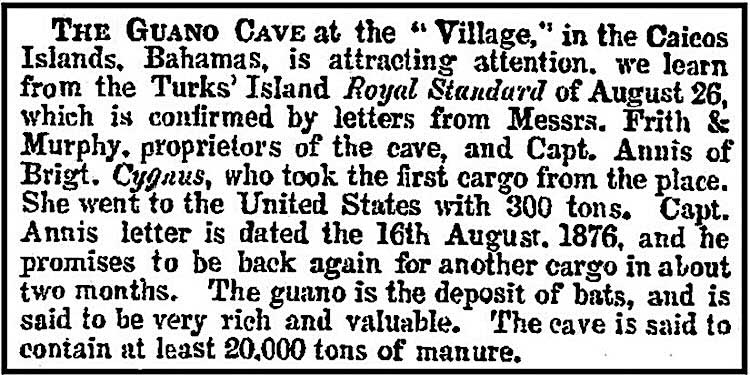
This is the first paragraph of an article extolling the guano found in Conch Bar Cave on Middle Caicos. It was published in the Bermuda Gazette on October 10, 1876.
John Reynolds began “mining” guano from caves on his property in 1882. Since his tramway wasn’t completed until 1888, as his advertisement states, guano would have been hauled from the caves to the pier at Jacksonville Creek on the backs of men and mules until the tramway became operational.
There is a swamp between Edison’s Cathedral Cave at Cape Comete Hill and the pier at Jacksonville Creek. To cross it, a stone causeway was constructed, but when? It’s possible guano mining was not undertaken from Edison’s Cathedral Cave until the causeway was completed or the causeway could have been built several years before the tramway became operational. Another possibility—guano from Edison’s Cave might have been shipped from a pier or wharf at the settlement known as Jacksonville until the causeway was completed.
It’s curious that Reynolds began building his tramway system in 1887 or 1888, since the market for bat guano reached its peak in the Bahamas and Caribbean in 1885 due to competition from Chilean nitrates and synthetic fertilizers. Did Reynolds offer his property on East Caicos for sale in 1888 because guano had “played out” or because the market was such that it was no longer profitable to export it? Or was there another reason?
Big changes in 1890
John Reynolds died in March 1890 without having sold or leased his East Caicos property. A month later, his wife and children leased the East Caicos property to what would become the East Caicos Company, Ltd., which was in the business of cultivating agave plants for the production of sisal fibre. (See my article on the East Caicos Company’s sisal enterprise in the Spring 2026 Times of the Islands at https://www.timespub.tc/2026/04/a-fleeting-success/).
Tons of guano stored on East Caicos
In August 1890, Commissioner Henry Jackson of the Turks & Caicos Islands visited East Caicos to look over the operations of the East Caicos Company. In his report to the Jamaican Government, Commissioner Jackson stated, “At present, about two-thirds of the island is held as a cattle ranch, there being about 1,000 head on the island, and there is a considerable quantity of cave earth [guano], about 200 tons of which has been stored, and was awaiting shipment at the time of my visit.” The report goes on to discuss the island’s suitability for producing sisal.
Were these 200 tons of guano stored on East Caicos mined from the caves recently or had it been mined a year or more earlier and stored there because it had become unprofitable to export it?
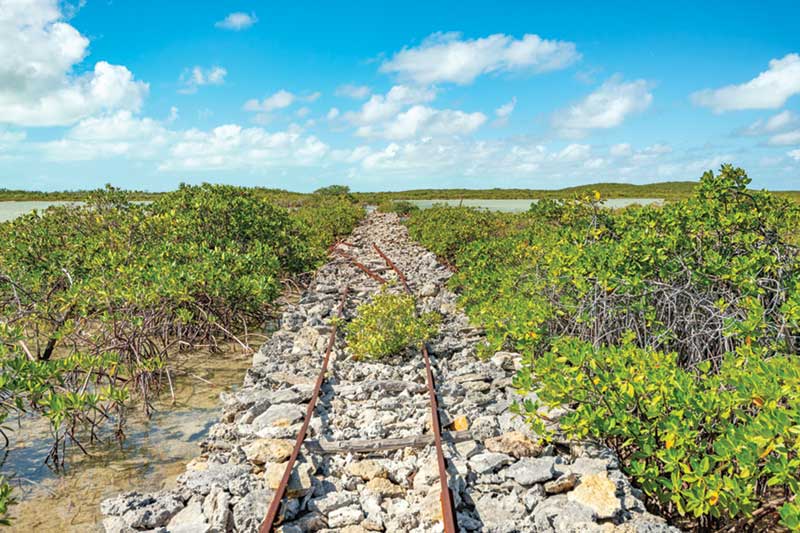
John Reynolds’ rail system crosses a swamp on a stone causeway. The causeway was located between Edison’s Cathebral Cave and Stubbs’ Guano Cave and Cave Old No. 2.
Summary
Various reports and articles about John Reynolds and his operations on East Caicos say that the guano had “played out” in the mid to late 1880s. However, based on the Commissioner’s 1890 report, this is not true. We may never know for sure why Reynolds advertised his East Caicos holdings for sale in late 1888, or if it had anything to do with guano.
Reynolds was 60 years old in 1888 and may have been in poor health. This possibility is supported by the fact that he wrote his will in 1889 to say, “Being of sound mind, but advanced in years owing to the uncertainty of life deem it advisable to make this my last will and Testament.” Two months later Reynolds wrote an addendum to his will, and a month after that he died.
The 200 tons of guano the Commissioner found stored on East Caicos in late 1890 is apparently gone—reliable sources have visited the caves in recent years and did not find it. It’s possible the East Caicos (sisal) Company found the guano and used it to fertilize their fields of agave plants or they might have exported it.
John Reynolds was a most interesting man. You can read more about him in the Summer 2023 issue of Times of the Islands at: https://www.timespub.tc/2023/06/john-of-all-trades/.
The author wishes to thank the following for their help making this article possible: Mark Parish of Big Blue Collective for his first-hand knowledge of the caves on East Caicos; Kim Mortimer of Kim Mortimer Photography for her wonderful photographs; Agile LeVin for his photographs and insights into Reynolds’ tramway and the guano caves and Tom Ellis of GroveGrafx Design.
What's Inside The Latest Edition?

On the Cover
Local photographer Watsonne Morency (www.watsonnephotography.com) took to The Shore Club to capture this image of Miss Turks & Caicos International 2026 Adesha Gustave.
Our Sponsors


Leave a Reply